
 NGRN
NGRNAnalytical review by New Geopolitics Research Network
Russia’s full-scale invasion has confirmed what many defence planners suspected but few had fully internalised: space is no longer a supporting backdrop to terrestrial operations. It is a contested operational enabler in its own right — providing the intelligence, communications, navigation and timing that modern forces require to fight, manoeuvre and survive. In Ukraine, satellites have become both an instrument of resilience and a target set, shaping operational tempo on the ground and strategic decision-making in capitals.
The decisive change is not merely technological; it is structural. The commercialisation of space has dismantled the old state monopoly over “eyes in the sky” and satellite communications. Today, private constellations and services can be contracted, scaled and integrated at speed — and, crucially, accessed by a much wider set of actors than in previous wars. That democratisation cuts both ways: it empowers defenders and coalitions, but it also creates new security and governance risks around access, supply chains and sanctions compliance.
1) Space-based ISR: from premium asset to mass service
Space-enabled intelligence, surveillance and reconnaissance (ISR) has shifted from being an elite national capability to something increasingly resembling a commodity — albeit one still shaped by political permissions and commercial terms.
Commercial optical imagery has been central to Ukraine’s ability to track force concentrations, monitor lines of communication, and conduct rapid battle damage assessment. The operational significance is the compression of the “find–decide–strike” cycle: high revisit rates and quicker dissemination reduce the defender’s uncertainty and force the attacker to invest more in dispersion, concealment and deception.
However, optical systems remain constrained by weather, light conditions and, in some cases, smoke and battlefield obscurants. The war has therefore underlined the importance of persistence across conditions – which points directly to radar imaging.
2) SAR: persistence, night-and-weather advantage, and a new baseline for concealment
Synthetic Aperture Radar (SAR) has become one of the most operationally consequential space technologies in this conflict. Unlike optical sensors, SAR can “see” through cloud cover and at night, delivering more reliable monitoring in the conditions that routinely degrade classical imagery. This creates a more persistent surveillance environment, narrowing the window for large-scale movement and increasing the cost of poor concealment discipline.
Ukraine’s access to SAR has also become a case study in the fusion of public interest, commercial capability and wartime necessity. The broader point for European defence is clear: SAR is no longer a niche intelligence product. It is becoming a baseline requirement for resilient ISR, particularly when the adversary will actively exploit weather and darkness to conceal manoeuvre.
3) SATCOM in LEO: the nervous system of modern operations – and a strategic dependency
If ISR is the “eyes”, satellite communications (SATCOM) is the nervous system. The most visible example is Starlink, which has played an outsized role in sustaining communications across Ukraine under conditions of kinetic attack and aggressive electronic warfare. It has enabled distributed command and control, supported drone operations, and helped maintain connectivity during power disruptions — a blend of military and civil resilience that is hard to replicate with terrestrial infrastructure alone.
Yet the war has also exposed the strategic risks of dependence on a single commercial provider.
A major global Starlink outage on 25 July 2025 disrupted Ukrainian military communications for more than two hours, according to Ukrainian officials cited by Reuters. The incident was reportedly linked to an internal software failure — a stark reminder that “space resilience” can be undermined not only by enemy action but by software fragility and corporate operational risk.
For defence planners, the lesson is blunt: LEO SATCOM is indispensable, but reliance without diversification is a vulnerability. Alternatives — whether through European providers, multi-provider architectures, or dedicated government-backed services — are not optional embellishments. They are a strategic hedge.
4) Navigation and timing (PNT): the hidden multiplier — and the pressure of jamming
Satellite-based positioning, navigation and timing (PNT) is often the least visible element of space power, but it is among the most decisive. Precision strike, UAV navigation, synchronised manoeuvre, and even basic logistical efficiency are all degraded when GNSS is denied or manipulated.
Ukraine’s battlefield has been an intense laboratory for jamming and spoofing, forcing both sides to adapt with layered navigation solutions, improved inertial systems, terrain-referenced methods, and better mission planning for contested electromagnetic environments. The broader strategic takeaway is that space dependency must be treated as a warfighting reality: the more digitised the force, the more it must train to operate when PNT is degraded.
5) Counter-space in practice: cyber and electronic warfare over kinetic spectacle
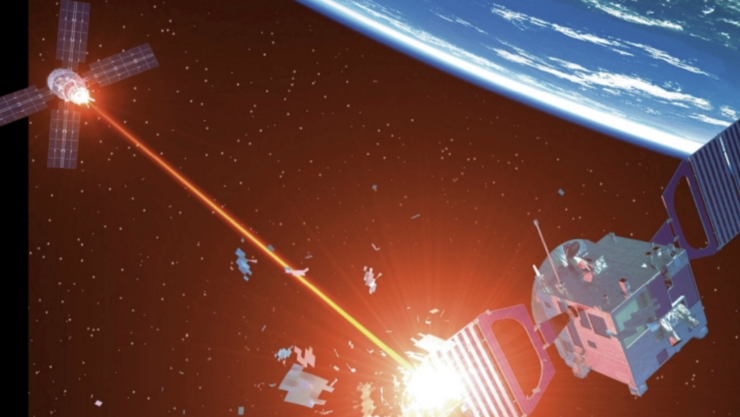
While public imagination often gravitates towards kinetic anti-satellite (ASAT) strikes, the Ukraine war underscores a more probable pattern: counter-space pressure through cyber and electronic means against the broader “space service chain” — satellites, ground stations, user terminals, and the software and cloud infrastructure that binds them.
A defining case is the KA-SAT cyberattack that hit Viasat’s network around the opening of the invasion. Viasat’s own incident overview describes a deliberate cyberattack on 24 February 2022 that caused a partial interruption of KA-SAT service and affected customers in Ukraine and elsewhere in Europe.
This model of attack is strategically attractive: it can be scalable, deniable, and operationally disruptive without the escalatory baggage of kinetic ASAT. The implication for Europe and Ukraine is that space resilience is not solely about satellites. It is about hardening ground segments, cyber defence, terminal security, supply chain integrity, and rapid restoration capacity.
6) From ad hoc access to institutional strategy: Ukraine’s move towards space governance
Perhaps the most important development is institutional. Ukraine has begun to formalise its approach to military space rather than relying purely on emergency arrangements and partner goodwill.
In March 2025, Ukraine’s Ministry of Defence announced it had established a Space Policy Directorate, intended to consolidate capabilities and advance the military space sector. In subsequent communications, the Ministry framed the logic in practical terms: accelerating access to required technologies, shaping transparent procedures for requesting space services, and building partnerships across government, industry and international stakeholders.
This matters because it signals a shift from “access” to “policy”: from the procurement of discrete services to the design of a national and coalition space-enablement architecture.
7) Europe’s industrial response: SAR production, autonomy, and the logic of scale
The war’s demand signal is already reshaping European industry. In May 2025, Rheinmetall and ICEYE announced a cooperation pathway towards a joint venture for SAR satellite production in Germany, with manufacturing scheduled to begin in Q2 2026, and subsequent statements indicating locally produced satellites from 2026.
The strategic logic is clear: ISR demand is increasing, and Europe is seeking more autonomous access to space-based reconnaissance. The industrial lesson mirrors the operational one: resilience comes from scale, redundancy and supply security — and that requires domestic or allied production capacity, not only procurement contracts.
8) Operational implications: what the Ukraine war teaches about space power
Several conclusions stand out for professional defence audiences:
- Persistence is now a baseline. Adversaries will exploit weather and darkness; radar imaging and high revisit rates constrain concealment and expand surveillance windows.
- Space-enabled C2 must be diversified. LEO SATCOM is critical, but software failures, corporate decisions, and “grey-market” leakage can create operational shocks. Multi-provider architectures and fallback options are essential.
- Counter-space is already here — and it is often cyber or electromagnetic. Defending the space service chain is at least as important as protecting satellites.
- Institutional capacity matters. Ukraine’s move to establish dedicated space governance suggests the direction of travel: a permanent system for contracting, prioritising and integrating space services into military planning.
- European strategic autonomy will increasingly include “sovereign access to data”. Industrial moves towards domestic SAR production reflect an emerging consensus that space-based ISR must be treated as a core security capability, not a discretionary intelligence luxury.
Space is a warfighting infrastructure – treat it as such
Ukraine’s experience demonstrates that space technologies are not merely force multipliers; they are warfighting infrastructure. They enable command, protect critical systems, compress decision cycles, and underpin operational tempo. But they also introduce new vulnerabilities — corporate dependency, software fragility, cyber exposure, and governance dilemmas around access.
For Ukraine, the strategic task is to turn wartime improvisation into a durable architecture: diversified SATCOM, persistent ISR, and institutional mechanisms that secure and integrate services at speed. For Europe, the lesson is equally direct: if the continent is serious about deterrence and resilience, it must invest not only in platforms and munitions, but also in sovereign and coalition access to the orbital layer — the data, communications, and timing that modern defence now assumes.