
 NGRN
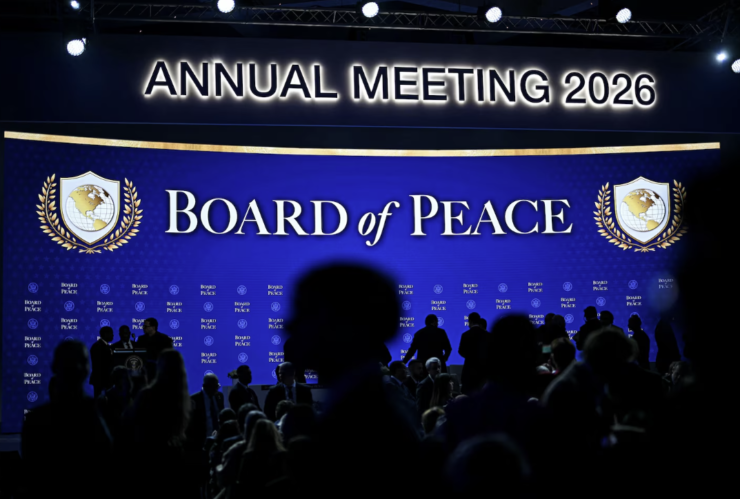
NGRNThe launch of Donald Trump’s Board of Peace in Davos on 22 January 2026 has already moved well beyond its advertised starting mandate on Gaza. In an internal assessment, the EU flags risks linked to an excessive concentration of powers in the hands of the chair and questions of compatibility with the Union’s legal principles. Against that backdrop, Volodymyr Zelenskyy’s position — that Ukraine cannot join a “peace board” while Russia and Belarus are members — is not only morally straightforward, but strategically sound: any format that seats the aggressor and the victim in the same “governing club” inevitably carries the risk of laundering aggression through procedure.
1) What is the “Board of Peace” – and why has it become political so quickly?
According to reporting, the Board is intended to begin with Gaza, but could later be expanded to other conflicts. Trump has argued that once fully established it could do “virtually anything it wants”, supposedly in conjunction with the UN. The problem is that its architecture looks less like a universal institution and more like a bespoke, personality-driven mechanism.
The most contentious design features include:
- A chair “for life”, with sweeping executive authority – including veto powers and the ability to remove members (as described in draft statute language cited in reporting).
- Three-year membership terms, but a de facto permanent status that can be secured via a $1bn contribution.
- A narrow legal anchor: the UN Security Council mandate reportedly covers Gaza only, and only until 2027 – leaving the Board’s role beyond Gaza legally ambiguous.
- Uneven buy-in: around 35 states are said to have agreed to participate, while several key US allies remain cautious or non-committal.
The result is a structure that resembles a “club” more than a rules-based multilateral body: limited membership, a financial threshold, and a personalised centre of decision-making.
2) Why the EU is alarmed: it is not just “about Trump”, but about governance
The EU’s concern is not simply that a new format exists. It is the precedent: major international decisions migrating into a framework where institutional checks are weak, authority is highly centralised, and legal compatibility with established systems is disputed.
The European External Action Service has reportedly warned that the Board’s statute raises questions about alignment with EU constitutional principles and could undermine the autonomy of the EU legal order due to the concentration of power in the chair. It also notes that the Board’s concept appears to move well beyond the Security Council’s limited Gaza mandate.
In other words, the EU reads the Board less as a technical peace tool — and more as a governance model that could bypass the normal constraints of international law and allied decision-making.
3) Zelenskyy’s red line: why Ukraine cannot “sit alongside” the aggressor
Zelenskyy has made it clear: Ukraine cannot realistically be part of the same “peace board” as Russia, and the same applies to Belarus. That position carries three strategic meanings:
- Do not legitimise the aggressor as a co-author of peace.
- Do not allow false symmetry (“both sides must compromise”) in a forum where the aggressor is granted an equal seat.
- Do not weaken Ukraine’s coalition support: participation alongside Russia/Belarus would hand third countries an easy talking point — that Kyiv itself accepted an “equal format” with the aggressor.
For Ukraine, Belarus’ inclusion is not a footnote. It is a signal that the Board could become a platform for reputational rehabilitation of hostile regimes through the optics of “peace membership”.
4) Forecast: why the Board could fragment the world rather than unite it
The likely trajectory in 2026–2027 is that the Board becomes one more engine of global fragmentation – by creating parallel channels of legitimacy and competing claims to the role of “peace-maker”.
The mechanics of fragmentation are familiar:
- Club logic over universality. The UN, for all its flaws, is built as a universal system. The Board’s model leans towards membership tiers, financial gateways, and concentrated leadership.
- Two kinds of legitimacy. Some states will treat the Board as a shortcut to US influence, funding, and deals; others will anchor themselves in the UN and regional organisations. That produces different rulebooks for different blocs.
- Erosion of rules-based trust. If settlements are increasingly brokered through ad hoc structures with broad discretionary power, other centres of power will respond by building their own “boards” and coalitions — multiplying competing institutions rather than strengthening one.
5) Will this dilute the UN’s role? Yes – but the Board is unlikely to become a global “manager”
The UN’s role may be diluted in practice and symbolism as more diplomacy shifts into exclusive formats. Yet the Board is unlikely to become a full-scale universal international organisation with genuine “global management” functions, for several reasons:
- No universal mandate. A time-limited, conflict-specific legal basis cannot sustain a global remit.
- Limited great-power legitimacy. A credible “global manager” requires broader buy-in among the UN Security Council’s permanent members — which is not evident.
- Legal and constitutional barriers in democracies. The EU’s own alarm highlights the constraints that rule-of-law systems impose on participation in governance structures with concentrated, quasi-personal powers.
- Dependence on a single political figure. A “chair for life” is not institutional resilience; it is personal architecture – potentially effective in the short term, fragile in the long term.
6) What this means for Ukraine: practical conclusions
- Hold Zelenskyy’s line as a national-security position: no participation in a format where Russia and Belarus are framed as “members of peace” while aggression continues.
- Synchronise with the EU stance: Europe’s governance and legality concerns provide a ready diplomatic shield against pressure to “join”.
- Insist on the principle: the aggressor cannot be a co-guarantor of peace. Without safeguards, the Board risks becoming a mechanism for a deferred, repeatable war.
- Use the Board’s existence as leverage, not as a substitute for allied guarantees: prioritise bilateral and coalition instruments (air defence, sanctions architecture, security commitments, recovery), avoid symbolic formats that elevate the aggressor.
- Anchor any “peace” discussion in accountability and law (reparations, compensation mechanisms, justice instruments). Without consequences for aggression, “peace” becomes a political bargain — and an invitation to повторення.
The Board of Peace may become an additional channel for talks, but it is unlikely to replace universal institutions. For Ukraine, the strategic task is to prevent a “peace club” from turning into a vehicle for legitimising aggression — and to preserve a coalition anchored in Europe and international law as the world drifts towards competing, parallel formats.