 NGRN
NGRNUkraine’s defensive campaign is showing signs of greater resilience and an increasing capacity to regain ground. The September assessment by NGRN identifies a marked slowdown in Russian territorial gains during August alongside rising Russian losses. If sustained, this would represent a significant deterioration in Moscow’s return on its expenditure of men and matériel. The evidence supports cautious optimism, although a favourable monthly trend is insufficient to establish a decisive shift in the war.
Across the northern sectors, Russian operations remain focused on small infantry assaults, infiltration and strikes against Ukrainian supply routes. Pressure along the Sumy border seeks to tie down Ukrainian reserves, while fighting around Vovchansk and Kupiansk continues to impose heavy demands on logistics and troop rotation. Further south, Kostiantynivka and the approaches to Sloviansk remain under considerable pressure. Russia’s use of glide bombs, drones and long-range fires allows it to degrade Ukrainian defensive positions even where its ground forces struggle to advance.
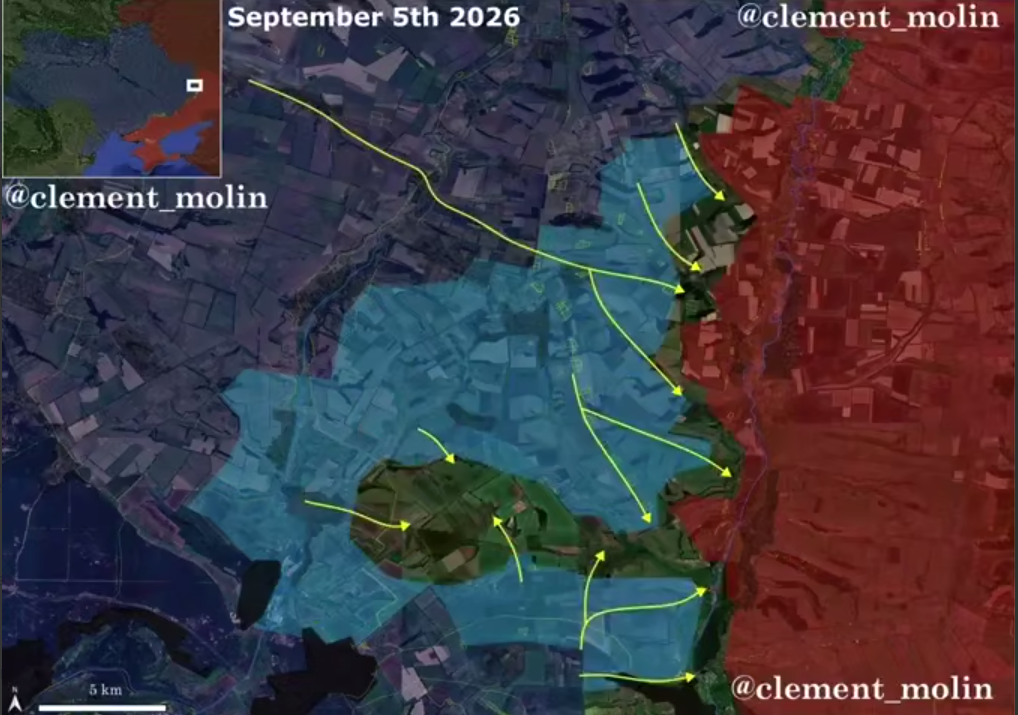
The most consequential recent development is the emerging picture of Ukraine’s counter-offensive north of Lyman. In an assessment published on 8 September, French OSINT analyst Clément Molin credited Ukraine’s 3rd Army Corps with cutting the Russian salient and liberating more than 200 square kilometres during approximately four months of operations. This was a sustained campaign whose results are only now becoming publicly visible. The territorial figure remains an open-source estimate, with Russian elements reportedly still present west of Kolodiazi.
The operational significance extends beyond the ground recovered. The salient had provided Russia with a potential springboard towards Lyman and opportunities to threaten the northern approaches to Sloviansk and Ukraine’s wider defensive belt. Its reduction should complicate Russian efforts to outflank these positions and ease pressure on northern supply routes. On the available evidence, the operation has bought Ukraine valuable defensive depth and time, whilst demonstrating that Russian territorial gains can be reversed through sustained local action.
The counter-attacks described in the original assessment near the Dnipropetrovsk–Zaporizhzhia–Donetsk regional junction reinforce this picture of an increasingly active Ukrainian defence. Their value lies in disrupting Russian preparations, improving defensive positions and forcing the enemy to reconsider the allocation of forces. Taken together, these developments suggest that Ukraine is recovering the ability to shape engagements on selected sectors.
The wider balance nevertheless remains contested. Reporting on 8 September recorded renewed Russian territorial gains elsewhere, underlining the uneven character of the front. The central judgement is that Ukraine has improved its capacity to absorb pressure and recover local initiative. Whether this develops into a durable operational advantage will depend on preserving trained infantry, sustaining ammunition and drone supplies, protecting logistics and retaining reserves capable of exploiting further opportunities.