
 Mykhailo Samus
Originally, the article was published at https://ukraineverstehen.de/ in German language
Mykhailo Samus, Director, New Geopolitics Research Network
When faced with a large-scale Russian attack, Ukraine’s sole opportunity for survival lay in employing non-linear, asymmetric, and high-tech approaches. Simultaneously, asymmetry needed to extend beyond weaponry, encompassing doctrines, tactics, and overall strategy.
This is primarily about applying the network-centric warfare concept as the cornerstone of the Ukrainian Armed Forces modern doctrine. Network-centricity is the integration of intelligence, control and destruction capabilities into a single system. This system must determine the coordinates of enemy targets as quickly as possible, in real time, transmit them to the command post, and then – after a decision is made – to the means of destruction. In modern warfare, the winner is the one who has the highest speed of the so-called control cycles (target coordinates – decision – destruction).
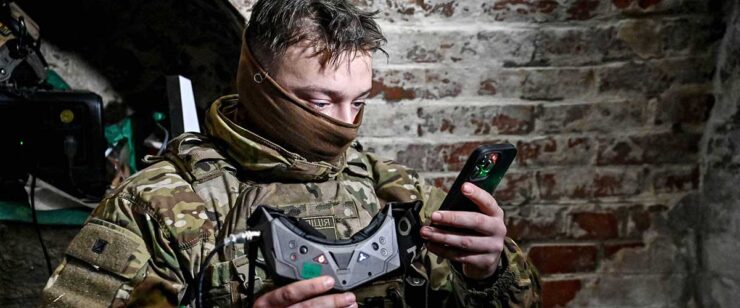
The concept of network-centric warfare is not new. For several decades, advanced armed forces have been trying to achieve the shortest possible control cycles and thus gain an advantage on the battlefield. The massive use of unmanned and autonomous systems has been a breakthrough in this area. Drones, which can be used as reconnaissance tools and strike weapons (often performing these functions simultaneously), have revolutionised the theory and practice of armed struggle. The time required from detecting a target to making a decision to destroy and, in fact, defeat the enemy has been reduced to just a few seconds. And this is not the limit. The introduction of artificial intelligence, which can identify and destroy targets without operator intervention, further accelerates the dynamics of combat. The function of the commander/operator in such systems is to make a decision to destroy the enemy. The rest of the work is done by technology.
At the same time, the massive use of drones and the avalanche-like growth of information that is transmitted and processed for decision-making requires the same rapid improvement of automated control systems. Therefore, in my opinion, the study of Ukraine’s success in military technology should begin with the phenomenal development of automation and integration of intelligence and control systems into a single matrix.
As an example, we can take the Kropyva tactical command and control system[1]. The inception and incorporation of Kropyva commenced as a volunteer initiative in 2014 when a group from Army SOS started providing tablets to the military. In 2018, the developers at the Logika Design Bureau generously contributed Kropyva, along with its source code and a license, to the Armed Forces. This system facilitates the automation of various command and control tasks at different levels, such as battalion, company, platoon, and individual vehicle. Essentially, it aids in amalgamating reconnaissance, control, and firepower into a unified information field.
Another successful example is the Delta system[2], which is actually a military cloud-based online service. The development of Delta’s situational awareness system began in 2015 by the Aerozvidka volunteer team. Delta is an online system that provides real-time information about the tactical and operational situation on the battlefield. Thanks to Delta, soldiers can see the battlefield online with the location of enemy forces. Data from aerial reconnaissance, satellites, drones, stationary cameras, radars, chats, etc. are pulled into the integrated informational platform. Delta is currently an important component of the Armed Forces’ military operations planning[3].
Concerning the introduction of technological solutions and new models of drones, electronic systems, and weapons systems, several hubs have been set up in Ukraine to quickly incorporate them into the testing and adoption process of the Armed Forces of Ukraine to eliminate bureaucratic procedures and reduce all necessary stages.
The Ministry of Defence of Ukraine has created a special platform – The Innovation Development Accelerator – responsible for optimising the process of adopting new weapons and military equipment into the service of the UAF[4]. As a direct outcome of the Accelerator’s initiatives, the process of integrating weapons and equipment into the service of the Ukrainian Armed Forces has been streamlined to just 1.5 months, a substantial improvement from the previous timeline of over 2 years. The Accelerator’s influence has been especially pronounced in the incorporation of new military technologies, given the continuous emergence of innovative developments from Ukrainian companies.
The Ministry of Digital Transformation also created Brave1[5], a cluster to promote the development of MilTech. The main task of Brave1 is to coordinate the activities of government agencies – the Ministry of Defence, the Armed Forces, the Ministry of Digital Transformation, the Ministry of Economy, the Ministry of Strategic Industry, the National Security and Defence Council – in the development of defence technologies and production. Overall, the Accelerator and Brave1 form a new ecosystem for the development, production and adoption of military technologies.
A few words about the programs that have become the driving force behind the Ukrainian drone and other MilTech developments. First of all, this is the Army of Drones project as part of the national crowdfunding campaign United 24[6]. Thousands of drones have been purchased and far more than 10,000 drone operators have been trained as part of the Army of Drones project[7]. Also, as part of the United 24 campaign, the process of creating maritime drones was launched, which later became a separate area of development of maritime platforms at the state level. As a development of the maritime drone sphere, Project FURY (First Ukrainian Robotic Navy) is starting recently to let the Ukrainian Navy get the dominance over Russian Black Sea Fleet. The launch of the Army of Robots project has also been announced, which will develop the latest robotic systems in the interests of the UAF. In addition, the creation of the Army of Electronic Warfare Systems has begun to give impetus to the mass production of electronic warfare systems.
Just to comprehend the scale of the technological shaft that is being born in Ukraine, imagine that at the beginning of 2024 there are about 200 Ukrainian drone manufacturers, most of which are private companies[8]. As for the number, according to information from various sources, at the end of 2023, up to 50 thousand different types of drones were being manufactured in Ukraine monthly[9]. The majority of them are First Person View (FPV) drones, which have really changed the nature of combat operations. For 2024, there are ambitious plans to further increase the production of drones. The state budget of Ukraine for 2024 allocates Euro 1,1 billion for drones (both aviation and maritime systems)[10]. As per Minister of Strategic Industry Oleksandr Kamyshyn, Ukraine has set ambitious production goals for 2024, aiming to manufacture 1 million FPV drones, over 10,000 medium-range strike drones, and more than 1,000 drones with a range of approximately 1,000 kilometers.
In the current landscape, it is evident that drones and emerging technologies have evolved into pivotal instruments, enabling Ukraine to establish an asymmetrical edge in its standoff against Russia’s formidable military and resource apparatus. However, the war is far from concluded. Regrettably, Russia possesses considerable financial resources derived from oil sales, enabling the acquisition of substantial microelectronics for missile production, procurement of Iranian drones, and substantial munitions orders from North Korea. Ukraine is compelled to continually strive for technological, doctrinal, tactical, and administrative advancements to maintain an asymmetrical advantage in the face of the Russian military’s reliance on sheer quantity, Soviet-era hardware, and the relentless use of “artillery ramparts” and infantry “meat assaults” in attempts to overpower Ukraine.
[1] https://armyinform.com.ua/2020/07/06/dlya-chogo-kropyva-potribna-vijskovym/
[2] https://delta.mil.gov.ua/auth/login
[3]https://www.slovoidilo.ua/2023/08/09/infografika/bezpeka/vijskova-platforma-delta-vidomo-pro-systemu-upravlinnya-zsu
[4] https://mil-tech.gov.ua/en/about-accelerator
[5] https://brave1.gov.ua/
[6] https://u24.gov.ua/
[7] https://biz.censor.net/resonance/3448681/armiya_droniv_yak_pryvatni_vyrobnyky_bezpilotnykiv_osvoyuyut_oboronnyyi_byudjet
[8] https://www.radiosvoboda.org/a/news-minstratehprom-vyrobnyky-droniv-v-ukraini/32689460.html
[9] https://forbes.ua/innovations/ukrainski-inzheneri-pratsyuyut-u-boeing-ta-airbus-virobniki-droniv-strazhdayut-cherez-defitsit-kadriv-yak-rozvyazati-tsyu-problemu-20112023-17379
[10] https://www.kmu.gov.ua/en/news/verkhovna-rada-ukrainy-pryiniala-derzhbiudzhet-na-2024-rik