
 NGRN
NGRNAtreyd DWS-1 “drone wall” (France)
System overview
The Atreyd DWS-1 is a modular “drone wall” concept designed as a last-ditch layer of air defence against Shahed/Geran-2-type UAVs, loitering munitions and glide bombs with UMPK kits. After cueing from radar, the system launches dozens – potentially scaling to hundreds – of FPV-type interceptors from modular launch stations. An AI engine coordinates the formation, manoeuvre and detonation of the interceptors, building a multi-layered barrier in the air.
The manufacturer presents DWS-1 as a GPS-independent system optimised for dense electronic warfare environments, with unused drones able to return for re-use. One operator is claimed to control around 100 drones simultaneously and test campaigns reportedly achieved 100% interception, although this has not yet been validated in combat. A first system is being considered for trials in Ukraine.
Key components
- Sensor layer: integration with existing radar(s) providing initial detection and cueing.
- Launch/logistics modules: containerised ground stations with interceptor “magazines”, in fixed or mobile configurations.
- FPV interceptors: small UAVs with warheads detonating near the target to generate a fragment/overpressure kill.
- AI-enabled control node: forms and dynamically reshapes the aerial “curtain” and manages multiple simultaneous intercepts.
- Communications and EW resilience: advertised as GPS-independent and designed to operate under jamming.
- Integration interfaces: intended for linkage into wider sensor/C2 networks, though technical detail remains limited.
Distinctive features and innovations
- AI-orchestrated aerial barrier that adapts in real time to target speed, altitude and course, including glide bombs.
- High degree of automation: one operator supervising large drone groups, with scope to scale swarms further.
- GPS-independent operation, a critical parameter for counter-UAS in contested electromagnetic environments.
- Partial re-usability of interceptors that do not detonate, reducing life-cycle costs.
Advantages
- “Last-mile” layer: closes the gap between traditional surface-to-air missile systems and the asset being defended, where SAM engagement becomes uneconomical or tactically sub-optimal.
- Improved cost-exchange ratio: cheap interceptors, potential re-use and scope for localised production (France/Ukraine) against low-cost threats such as Shaheds and glide bombs.
- Rapid deployment and scalability: containerised architecture with static and mobile options, enabling modular build-up of local air defence.
Limitations and risks
- Heavy dependence on high-quality radar cueing – without consistent tracking, the effectiveness of the “curtain” degrades quickly.
- Weather and environmental sensitivity: strong winds, precipitation, icing, smoke or dust may significantly reduce FPV performance.
- Fragment hazard over urban areas, requiring careful planning of safety sectors and approach corridors.
- Questionable effectiveness against high-speed or higher-altitude targets, including some glide bombs and jet-powered UAVs.
- Substantial logistic burden: batteries, warheads, rapid turnaround and secure resilient communications and cyber protection.
Assessment for Ukraine
DWS-1 appears to be a promising, potentially low-cost final layer against massed UAV threats, with the ability to offload cheaper targets from missile-based air defence and increase the survivability of critical infrastructure. Success will depend on robust integration into radar networks, clear rules for urban employment and sustainable logistics for mass deployment. Initial combat use in Ukraine will be decisive in validating performance claims and informing any scaling decisions.
CICADA / SKY SPHERE counter-UAS system (Diehl Defence, Germany)
System overview
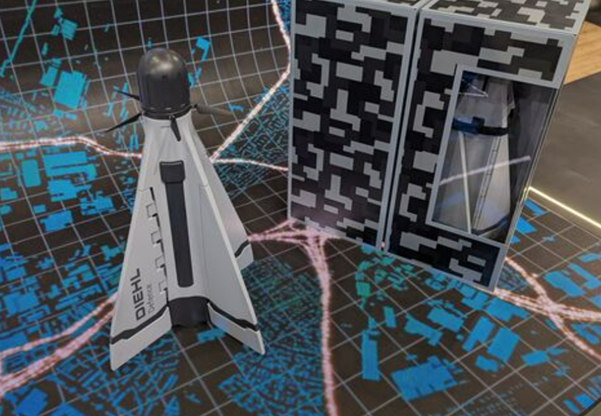
CICADA is an electrically powered interceptor (“eMissile”) within Diehl Defence’s modular SKY SPHERE short-range air defence architecture. It is designed to defeat UAVs and loitering munitions in the close-in, object-defence zone. The system offers two effectors: a lethal interceptor with fragmentation warhead and a non-lethal net-based variant, enabling both battlefield employment and use in urban or sensitive environments.
Targets are detected and pre-cued by ground-based sensors; mid-course guidance is provided via datalink, with an on-board radar seeker taking over in the terminal phase.
Key components
- CICADA interceptor (eMissile): electric-driven UAV-type interceptor in lethal and net-based non-lethal variants, intended to engage both individual UAVs and small swarms.
- Sensors and C2: SKY SPHERE provides an open, modular architecture with standardised interfaces for a range of radars, EO sensors and command systems, in mobile or containerised formats.
- Additional effectors: potential integration with HPEM (high-power electromagnetic) systems and a rotary cannon on a Kinetic Defence Vehicle platform for layered C-UAS effect.
Distinctive features and performance
- Dual-mode (lethal/non-lethal) employment, minimising collateral damage in dense urban environments or at public events, while retaining a hard-kill option.
- Electric propulsion and low acoustic/thermal signature, supporting discreet operation in object and urban defence.
- Standardised integration into wider multi-layered air defence through external cueing and autonomous terminal engagement.
- Indicative performance: effective range of roughly 4–4.5 km against Shahed-type targets; speed above 200 km/h; endurance of around 3–4 minutes.
Advantages
- Fills the “last-mile” niche between EW/HPEM effects and conventional SAMs, where missile use is uneconomical against cheap UAVs.
- Controlled collateral effects via the non-lethal net variant for high-density environments.
- Modularity and compatibility with existing sensors and networks, enabling swift integration into national air defence architectures.
- Synergy with IRIS-T SLM and other Diehl systems, preserving expensive missiles for high-priority targets.
Limitations and risks
- Extended development timeline: public demonstrations since 2024, with serial availability unlikely before 2026–27, limiting near-term impact on the current Russian drone campaign.
- Strong reliance on sensor and C2 quality – radar tracking and datalink robustness are central to effectiveness.
- Weather and urban constraints: rain, wind and the need for safe detonation sectors can limit employment in cities.
- Speed/altitude envelope: optimised for slow, low-flying UAVs; higher-end threats (cruise missiles, fast munitions) remain the remit of systems such as IRIS-T.
- Small warhead (~0.5 kg in open sources) may require higher engagement density against more robust targets.
Assessment for Ukraine
CICADA/SKY SPHERE offers a potentially affordable lower tier complementing IRIS-T SLM and other SAMs, aimed at mass UAV raids and with valuable non-lethal options in urban settings. The key questions for Ukraine are the real cost-per-kill against Shaheds and slow targets, the maturity of the product, and the ability to integrate into existing sensor networks. Given the early stage of serialisation and uneven public data, Ukrainian range and field trials would be essential.
Wolf 25 AD mobile SHORAD/C-UAS system (DefTech, Slovakia)
System overview
Wolf 25 AD is a mobile SHORAD and counter-UAS platform tailored to contemporary drone-heavy battlefields. It combines the Wolf 4×4 MRAP chassis with the remotely operated MANGART 25 turret (Valhalla Turrets, Slovenia) and a 25×137 mm Oerlikon KBA cannon, allowing engagement of UAVs – including FPV and Lancet-type systems – as well as lightly armoured ground targets.
Following its debut at IDET-2025, initial vehicles have reportedly been sent to Ukraine for testing, with deployment in Ukrainian Armed Forces formations announced from autumn 2025, though open-source confirmation remains limited.
Key components
- Chassis: Wolf 4×4 MRAP with independent suspension, 6.7-litre diesel engine, automatic transmission, V-shaped hull and modular crew compartment, intended for long patrols and rapid redeployment.
- Turret module: MANGART 25 with Oerlikon KBA 25×137 mm cannon (Rheinmetall Italia), including programmable air-burst munitions.
- Radar: four AESA AMMR panels (Rheinmetall) providing 360° coverage; typical detection ranges cited as ~20 km for aircraft, 12 km for helicopters, ~10 km for cruise missiles/large UAVs, 8–10 km for Lancet-type systems and ~5 km for multirotors/FPV; up to ~150 simultaneous tracks.
- EO/IR sight: day/thermal cameras with auto-tracking, integrated into the fire-control system.
- C2 and options: open architecture for integration with wider sensor networks and potential addition of MANPADS, 70 mm rockets, ATGMs or EW modules.
Distinctive features and innovations
- The AESA radar + 25×137 mm cannon combination enables early detection of small, slow UAVs and engagement using programmable air-burst rounds that create a fragment cloud at the intercept point – effective against FPV and quadcopters.
- Full 360° coverage via four radar panels, with jam-resistant performance in contested electromagnetic environments.
- Multirole concept: one platform combines C-UAS and direct fire support for ground operations, reducing the need for separate dedicated vehicles.
- Engineering upgrades (dedicated generator, water cooling for radar) reflect a configuration designed for sustained operational use rather than demonstrations.
Advantages
- Favourable cost-exchange ratio: 25×137 mm rounds, particularly with air-burst, are significantly cheaper than SAMs, which is critical when engaging large numbers of low-cost drones.
- Mobility and survivability: MRAP chassis with high off-road performance enables convoy escort and frequent repositioning, complicating enemy counter-fire.
- Network compatibility: existing sensors and software facilitate integration into layered air defence and national radar frameworks.
- Emerging battlefield relevance, given reported testing in Ukraine and positive initial feedback cited by the manufacturer.
Limitations and risks
- Range constraints: practical engagement ranges against Shahed-type targets are likely limited to roughly 2–3 km, while such UAVs usually operate at 4–5 km altitude.
- Dependence on programmable ammunition: effectiveness against UAV swarms is strongly linked to the availability of air-burst rounds, making their supply chain critical.
- Additional power and cooling requirements increase service and logistic demands during prolonged operations.
Assessment for Ukraine
Wolf 25 AD addresses a critical gap for low-cost, mobile, close-in air defence: it removes “cheap” targets from the task list of medium- and long-range systems and strengthens the resilience of urban and point defence. Success hinges on securing sufficient stocks of programmable ammunition, refining rules of engagement in urban conditions and fully exploiting the radar’s potential within the wider Ukrainian air defence network.
TRL Drones Interceptor family (Czech Republic)
System overview
TRL Drones (Brno) has introduced two autonomous interceptor platforms: a small hard-kill drone optimised against Shahed-131/136 and similar UAVs, and a larger jet-powered interceptor designed to engage both unmanned and manned targets (including helicopters) and to conduct precision strikes against ground targets.
The core idea is a mass-produced, low-cost, missile-like interceptor operating fully autonomously from launch through target engagement to return-to-base, including in GNSS-denied and high-EW environments. The system is positioned as a new lower tier of air defence against mass drone raids. Optical AI guidance plus inertial navigation enable autonomous terminal guidance, while external radar provides initial cueing. The system was showcased at IDET-2025, with subsequent announcements of planned trials in Ukraine.
Key components
- Small “anti-Shahed” interceptor: take-off weight around 2.5 kg; up to 1 kg payload; speed up to ~250 km/h; range up to ~60 km; ceiling around 2.5 km; RTB capability in case of a miss; 3D-printed polymer airframe for low cost and fast replacement. Estimated unit cost is “a few thousand” US dollars.
- Larger jet-powered interceptor: length ~1 m; wingspan ~1.74 m; speed up to ~450 km/h; payload up to ~10 kg; range up to ~200 km; jet engine; catapult launch; fully autonomous flight and attack profile.
- Sensors and C2: external radar/sensor network provides initial target data; an on-board optical AI “seeker” and VIO/INS suite deliver GPS-independent terminal guidance.
Distinctive features and innovations
- Fully autonomous intercept chain from launch to engagement and RTB, reducing operator load and stabilising performance under EW.
- Optical AI seeker for target recognition and tracking in the visible spectrum, lowering dependence on radio links in the final phase.
- Scalable mass employment: 3D printing and modular design lower cost and shorten the repair cycle; cost-per-engagement is significantly below that of short-range SAMs.
- Jet-powered variant offers sufficient energy to engage manoeuvring, faster targets and conduct opportunistic strikes on ground targets.
- Containerised launch solutions enable rapid formation of interceptor “batteries” with short readiness times.
Advantages
- Provides a rational lower tier in the air defence architecture, delivering inexpensive shots against Shaheds, FPV and small aircraft, thereby freeing higher-tier systems.
- High resilience to EW/GNSS jamming through VIO/INS navigation and on-board optical guidance.
- Scalability against swarms, as batteries of launchers can generate missile-like engagement densities without consuming SAM stocks.
- Dual-role concept: the small interceptor for mass C-UAS employment; the larger one for helicopters and precision strikes.
Limitations and risks
- Warhead uncertainty: open sources mention the presence of warheads but rarely specify type or mass, complicating assessment of lethality and timelines to full operational readiness.
- Dependence on external cueing: without high-quality radar/EO networks the reaction window narrows and coverage deteriorates; integration into existing Ukrainian C2 is essential.
- Weather sensitivity of optical guidance: rain, fog and low light reduce AI seeker performance, implying a need for complementary thermal/ radar channels and defined night profiles.
- Logistics of mass employment: sustained operations require robust production of 3D-printed airframes, batteries, spares and maintenance capacity.
- Variation in published performance data, which underlines the need for national testing to validate real-world parameters.
Assessment for Ukraine
TRL Drones’ interceptors align closely with Ukraine’s requirement for an autonomous, low-cost “anti-Shahed” capability in the lower tier of air defence. Strengths lie in autonomy, GNSS-independent navigation, rapid deployment and attractive cost-per-kill. Key risks relate to warhead effectiveness, dependence on external cueing and data inconsistency. Given the intention to conduct trials in Ukraine and the country’s existing sensor network, a pilot deployment around energy infrastructure and key approach corridors appears reasonable, with scaling decisions driven by combat results.
AARTOS™ Anti-drone Jammers (Aaronia AG, Germany)
System overview
AARTOS™ Anti-drone Jammers are a family of electronic warfare systems developed by Aaronia AG and integrated into the wider AARTOS™ Drone Detection System (DDS). The range includes portable and mobile jamming stations with differing power levels and ranges. Depending on configuration, maximum quoted jamming distances reach around 10 km, with output power up to 800 W and a programmable frequency range up to 6 GHz, covering GNSS, ISM bands and common UAV control/data links. Both directional and omnidirectional antennas are supported, with sectorisation of up to eight sectors for full 360° coverage.
Within AARTOS™ DDS, RF monitoring, radar and EO sensors provide multi-sensor detection and identification, generating cueing for jammers, which are then employed in a controlled manner to reduce unnecessary interference.
Key components
- Portable jammer: up to ~2 km range, ~40 W output, one directional antenna and four fixed bands, intended for rapid local suppression of commercial drones.
- Six-band mobile jammer: ~3–4 km radius, ~170 W, single-sector configuration for mobile teams or vehicle-mounted use.
- Automatic 180°/360° sector jammer (FJ/“Sector”): ~3 km radius at around 390 W, with combinations of four directional and 1–4 omnidirectional antennas tuned to specific threat bands.
- Programmable 360° jammer: 4–10 km coverage, 240–800 W, antenna arrays with fully programmable frequency bands, sectors and algorithms, supplied as part of AARTOS™ X7/X9.
Parameters differ by antenna and amplifier suite; early product generations referenced configurations with up to 16 bands and total power exceeding 1,300 W.
Distinctive features and innovations
- Sectorised and “surgical” jamming: up to eight independently configured sectors with tailored bands and power levels, reducing collateral interference in urban environments and on friendly GNSS/communications.
- Programmable spectrum up to 6 GHz, covering major GNSS constellations (GPS/Galileo/GLONASS/BeiDou) and typical C2/video links of commercial drones (433 MHz, 915 MHz, 2.4/5.8 GHz), with options for customer-specific profiles.
- Tight integration with AARTOS™ DDS: continuous RF monitoring and AI-supported classification enable time-limited, track-driven activation (spot or barrage), improving efficiency and reducing unintended disruption.
- Flexible deployment options: from man-portable and vehicle-mounted systems to containerised or mast-mounted installations, controlled locally or from remote C2 nodes.
Advantages
- Strong economy of engagement for cheap and mass UAV threats: GNSS/C2 denial is substantially cheaper than firing SAMs or advanced kinetic effectors, particularly during large-scale Shahed attacks.
- Tailored configuration for specific areas of operation: programmable bands and sectorisation support targeted treatment of distinct threat sets (Shaheds, commercial quadcopters, FPVs) without blanket RF suppression.
- Scalability within air defence networks: integration with AARTOS™ DDS (radar/EO/RF) enables layered EW “domes” over cities or critical sites, activated automatically according to track data.
- Rapid deployment of portable and mobile variants for temporary coverage of critical nodes or convoy escort.
Limitations and risks
- Non-destructive effect: EW alone does not physically destroy the target. Shaheds may shift to alternative navigation modes and still reach their aim points, so jammers must be combined with kinetic effectors (guns, missiles, interceptors).
- Potential collateral impact on own GNSS and communications, and on civilian services, if frequencies and timing are poorly configured – a particular concern in urban environments.
- Strong dependence on accurate cueing: effectiveness rises sharply when integrated with radar and other sensors; without them, reaction windows shrink and jammers must operate longer, increasing the risk of unnecessary interference.
- Variation in public configuration data (3–10 km; 390–800 W and above), requiring precise definition of variants during procurement planning.
Assessment for Ukraine
AARTOS™ Anti-drone Jammers represent a flexible GNSS/C2 denial tool for the lower tiers of air defence, scalable from portable sets to fully programmable 360° systems with ranges up to around 10 km and tight DDS integration. For Ukraine, their main value lies in degrading the effectiveness of enemy UAV employment – including Shaheds – and in serving as a key element of a layered counter-drone architecture alongside kinetic systems such as SAMs, guns and drone interceptors.