
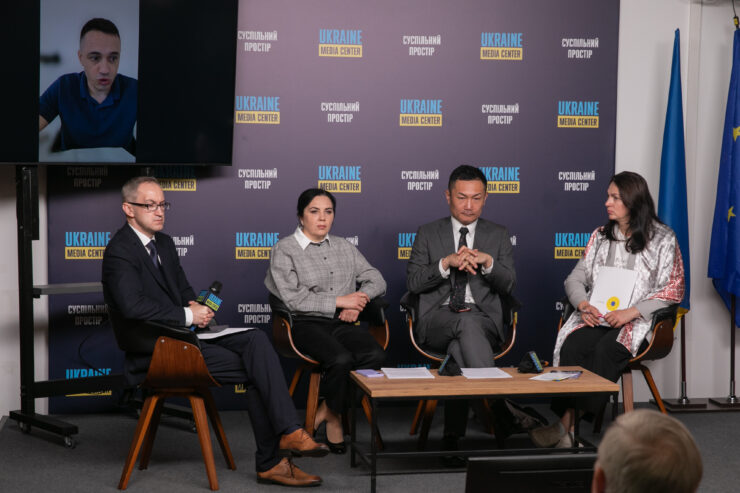
 Yurii Poita
Yurii Poita, the Head of Asia section at the NGRN, took part in a roundtable discussion organized by the New Europe Center, “The Asian Flank of Support for Ukraine (Japan, South Korea, and Taiwan): Why Partnerships Are Not a Given and How to Strengthen Them.” The event brought together Ukrainian and international experts to analyze the role of Asian democracies in supporting Ukraine and to identify promising areas for further cooperation.
Yurii, assessed the situation in Taiwan as difficult and increasingly complex, driven by both domestic and foreign policy factors. On the domestic front, he noted intensifying competition between the two dominant parties, the Democratic Progressive Party and the Kuomintang, with the latter’s popularity gradually rising – a party that advocates a friendlier policy toward the PRC. According to him, this raises concerns that such a policy could open the door to Chinese influence and propaganda and weaken the island’s defense programs. The speaker emphasized that this year’s local elections in Taiwan will serve as an indicator for the scenario of the 2028 presidential election, and cited last year’s “great recall” campaign against Kuomintang lawmakers – which failed entirely – as an example of the Democratic Progressive Party’s vulnerability, signaling to both the Kuomintang and China that the ruling party faces crisis-level problems.
The expert confirmed the point made by previous speakers about the growing interconnection between the Asia-Pacific and European theaters, noting an increase in Europe of related events, conferences, and war games exploring this linkage. As an example, he cited a war game in which he took part in Berlin a few months ago, involving European experts, diplomats, American representatives, and a representative of the Japanese government: under the scenario, in 2028 a Democratic Progressive Party leader comes to power in Taiwan, while a representative of the more anti-China wing comes to power in the United States, after which, in late 2028 – early 2029, China, having prepared its military component, launches an actual blockade of the island and a strategic deployment of forces in preparation for an invasion, in order to study Europe’s reaction. The outcome of the game was that Europe’s reaction proved very weak: it did not even impose sanctions on China, demonstrating the weakness of its position in responding even through economic means to such serious actions.
Yurii separately noted that the war game also examined the possibility of coordination between China, Russia, and North Korea – in particular, whether Russia would launch military action against NATO forces at the moment of a Chinese blockade or preparation for an invasion of Taiwan; although this question remained at the level of hypothesis, it was one of the central ones explored. In conclusion, he stressed that the situation around Taiwan will directly affect the European theater of military operations over the coming years, which requires serious coordination between Europe, the United States, and Asian partners. In his closing remark, Yuriy Poita pointed to the need to build a favorable infrastructure for cooperation, citing the visa issue (including the introduction of a visa-free regime, which Taiwan already has with nearly a hundred countries worldwide), and also drew attention to the significant growth in Taiwanese interest in defense cooperation with Ukraine, driven by Ukraine’s successes in producing weapons and drones – high-tech yet inexpensive – which the Ukrainian government should carefully study and make use of.
Full information about the event can be found here.