
 NGRN
NGRNZaluzhnyi on the Next Era of Warfare: Autonomous Systems, Digital Battlespaces and Ukraine’s Place in Future Alliances
Ukraine can have a future only if its security is guaranteed. This requires membership of alliances capable of responding to the emerging international order, General Valerii Zaluzhnyi, Ukraine’s Ambassador to the United Kingdom and former Commander-in-Chief of the Armed Forces of Ukraine, argues.
Ukrainians Abroad as a Strategic National Asset
- Enduring support for Ukraine rests not only on agreements between governments, but also on people. The Ukrainian community has helped make British support resilient across successive governments.
- The Association of Ukrainians in Great Britain, established in 1947, created a lasting political constituency for Ukraine. British citizens of Ukrainian heritage vote, influence public opinion and retain a strong emotional connection to their ancestral homeland.
- Ukraine should not view the return of all its citizens from abroad as the only desirable outcome. The approximately 336,000 Ukrainians now living in the UK could become a major source of political, economic and cultural influence over the next fifty years.
- Poland demonstrates the strategic value of a strong diaspora. Polish communities abroad contributed to the country’s Euro-Atlantic integration and subsequent economic development.
NATO and the Doctrinal Gap
- Zaluzhnyi remains a firm supporter of NATO. In 2019, he helped design reforms aligning Ukraine’s strategic command-and-control system and national legislation with NATO principles and standards.
- However, the strategic environment has changed fundamentally. NATO formed part of the post-1945 political, economic and military order, and that order is now under severe pressure.
- The Alliance’s military credibility cannot be separated from the cohesion of its political foundation. If the political architecture fractures, NATO’s ability to defend the old order will inevitably come into question.
- Technological development is advancing independently of political decision-making. Ukraine has employed almost the entire spectrum of conventional NATO weapon systems and associated doctrines available to it. Russia has progressively developed countermeasures against them.
- HIMARS, for example, helped create the operational conditions for the liberation of Kherson. Within weeks, however, Russian countermeasures significantly reduced its effectiveness. This illustrates how rapidly battlefield advantage can erode.
- Every new weapon generates new concepts of employment. These, in turn, require new force structures, training systems, procurement models and defence-industrial policies.
- Ukraine’s employment of uncrewed systems is already producing a new doctrine, although it remains under development because the technology and countermeasures are evolving continuously.
- NATO remains heavily influenced by doctrines inherited from twentieth-century warfare. Ukraine’s Armed Forces have moved into a fundamentally different, technology-driven battlespace. The Alliance must therefore develop new standards and operational concepts.
The Case for a New European Security Grouping
- Ukraine requires membership of a security bloc, but such a bloc cannot be purely military. It must combine political cohesion, economic integration and collective defence.
- Europe may need a new regional security framework designed specifically for the emerging threat environment.
- The UK-led Joint Expeditionary Force offers a promising foundation. Its Nordic and Baltic membership, geographical focus and NATO alignment make it a potential framework for closer Ukrainian integration.
Ukraine Must Be a Partner, Not a Military Contractor
- Ukraine must not be reduced to a source of combat experience, technology or manpower for European defence. Turning the country into a quasi-private military company would be strategically disastrous.
- Ukraine can help form the operational core of a stronger European defence posture, but this must be based on equal partnership and respect for Ukrainian national interests.
- No single European state possesses every capability required for future warfare. Norway has major energy and maritime assets; the UK has advanced space and defence capabilities; the Netherlands has critical semiconductor-manufacturing technology. Ukraine contributes unique combat experience, innovation and land-warfare expertise.
- These strengths should be integrated into a common strategy. Ukraine should join such a coalition as one of its principal members, not as an expendable provider of military capability.
Future Warfare: Autonomous Systems and the Digital Battlespace
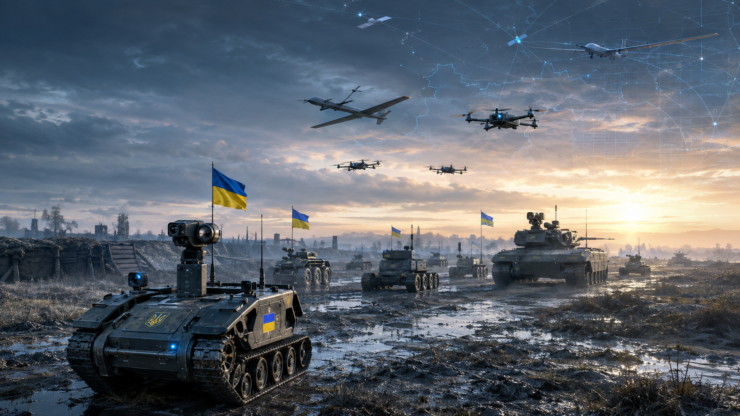
- Future wars will be fought across vast digital battlespaces populated by robotic and autonomous systems.
- These systems will operate in two principal modes: remotely controlled by human operators or equipped with onboard autonomy capable of making decisions without constant human direction.
- Human operators may be located thousands of miles from the physical battlespace. The distinction between the front line and the strategic rear will become increasingly blurred.
- Autonomous combat systems may become a strategic threat comparable to, or potentially more dangerous than, nuclear weapons. Their proliferation will be driven by technological progress rather than political consensus.
- Technological change is also reducing the strategic value of territorial annexation. An adversary may seize territory but remain unable to use, supply or exploit it if long-range systems can isolate it remotely.
- Ukraine’s concept for the remote isolation of Crimea, developed in 2023 and initially dismissed by US partners, demonstrated this logic. Persistent strikes can make occupied territory operationally and economically unusable without an immediate ground offensive.
- Russia established a land corridor between Donetsk and Crimea, but that corridor remains vulnerable to systematic interdiction. Possessing terrain is of limited value if the occupying force cannot sustain movement or logistics across it.
- Medium-range strike capabilities are evolving into deep-strike systems while their costs converge. A campaign can first target fuel depots, then fuel tankers, heavy transport and civilian vehicles used for military logistics. The cumulative effect is the disruption of movement between population centres and the isolation of occupied territory.
Five Operational Domains
Ukraine must be able to operate and survive across five interdependent domains:
- Maritime, including subsurface operations
- Land
- Air
- Space
- Cyber and the wider digital battlespace
Ukraine’s present capabilities are uneven:
- At sea, Ukraine can operate effectively with support from partners.
- On land, it can conduct operations with comparatively limited external assistance.
- In the air, Ukraine lacks the capabilities required to achieve control of the air independently.
- In space, it remains dependent on external providers for intelligence, surveillance, reconnaissance, navigation and secure satellite communications.
- In the digital domain, Ukraine has significant operational expertise but lacks some of the materials, manufacturing capacity and advanced components required for production at scale.
A future alliance should close these gaps by combining the capabilities and resources of its members. This includes access to counter-hypersonic systems, critical minerals, semiconductor technologies, space-based surveillance, secure communications and navigation.
Ukraine could theoretically build an independent space programme, but this would require investment on the scale of tens—or possibly hundreds—of billions. A more realistic option is to obtain these capabilities through a genuinely integrated security alliance.
Security as Ukraine’s Overriding Priority
- Ukraine must not trade its long-term security for short-term economic relief, energy supplies or political concessions.
- For at least the next fifty years, national security will remain Ukraine’s overriding strategic priority.
- Security is not an end in itself. It is the foundation on which economic recovery, investment, demographic resilience and political stability must be built.
- Without credible security guarantees, no sustainable programme of national reconstruction or economic development will be possible.
The Emerging International Order
- Since 2024, the war has entered a phase of attrition. A prolonged war of exhaustion is unlikely to produce a decisive victory and risks inflicting strategic defeat on both Ukraine and Russia.
- For the wider world, the war marks the beginning of an open struggle to rewrite the international rules and redistribute power.
- The institutions and political systems built after 1945 are increasingly unable to manage current pressures.
- A new global settlement—a modern equivalent of Potsdam or Yalta—may ultimately be required. It would have to establish new rules for security, power, technology and international competition.
- Ukraine’s task is to secure its place in this emerging order as a sovereign military and technological power, protected by alliances designed for the wars and threats of the future.
Based on an article published by Texty.org.ua